Project Details
NanoCore: An 8-bit CPU Emulator
NanoCore is a meticulously crafted emulator for a custom 8-bit CPU. Designed with extreme minimalism in mind, this CPU operates within a strict 256-byte memory space, with all registers, the Program Counter (PC), and the Stack Pointer (SP) being 8-bit.
This project serves as an educational exercise in understanding the fundamental principles of computer architecture, low-level instruction set design, memory management under severe constraints, and assembly language programming.
Website: nanocore.afaan.dev | DeepWiki: AfaanBilal/NanoCore
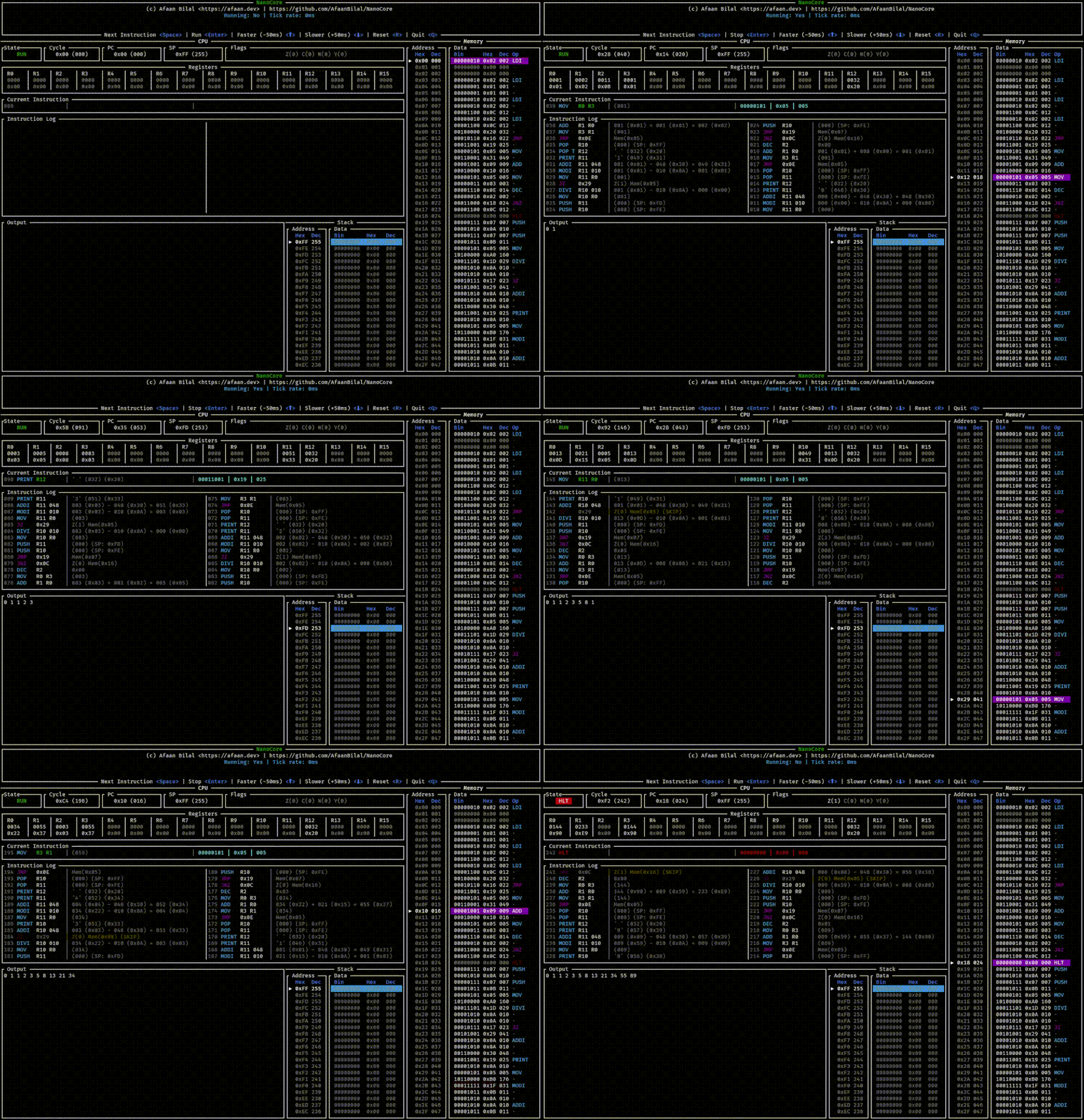
✨ Key Features
- True 8-bit Architecture: All general-purpose registers (R0–R15), Program Counter (PC), and Stack Pointer (SP) are 8-bit.
- 256-byte Memory: The entire addressable memory space is limited to 256 bytes (
0x00to0xFF). - Variable-Length Instruction Set: 1-byte, 2-byte, and 3-byte instructions to maximize opcode efficiency within the limited address space.
- Modular Design: CPU cycle broken down into distinct Fetch, Decode, and Execute phases.
- Inbuilt Two-Pass Assembler: Write NanoCore Assembly (
.nca) instead of raw machine code. - Terminal User Interface: Fully functional TUI with breakpoints for interactive debugging.
- Typed Error Handling: Stack overflow/underflow, division by zero, invalid operands, invalid opcodes, undefined labels, and runaway programs all surface as structured Rust errors.
📦 Installation
Option 1 — Compiled Binaries
Download pre-built binaries for your platform from the GitHub Releases page.
Option 2 — cargo install
cargo install nanocore
Option 3 — Build from Source
Requires Rust (stable).
git clone https://github.com/AfaanBilal/NanoCore.git
cd NanoCore
cargo build --release
🚀 Usage
Run a program
# Run a pre-assembled binary
cargo run -- programs/test.ncb

# Auto-assemble and run a .nca source file
cargo run -- programs/fib.nca

# Print CPU state after each cycle
cargo run -- programs/test.nca -s

# Print each instruction as it executes
cargo run -- programs/test.nca -i

# Raise the cycle budget for a long-running program
cargo run -- programs/screen.nca --max-cycles 4096
Assemble to binary
cargo run --bin nca -- -i example.nca -o example.ncb
Launch the TUI debugger
cargo run --bin tui -- programs/counter.nca
Run the test suite
cargo test
🧮 Architecture
| Component | Details |
|---|---|
| Registers | R0–R15, all 8-bit |
| Program Counter | 8-bit (0x00–0xFF) |
| Stack Pointer | 8-bit (stack: 0xEB–0xFF; 0xEA is the overflow guard) |
| Flags | Zero (Z), Carry (C), Negative (N) |
| Memory | 256 bytes total |
| Stack size | 21 bytes (0xEB–0xFF) |
| Max cycles | 1024 per run by default (--max-cycles) |
Memory Map
All 256 bytes are one flat, unprotected address space. The layout below is convention — nothing enforces it.
| Range | Size | Purpose |
|---|---|---|
0x00–0xA9 | 170 bytes | Program and data — programs load at 0x00 by default |
0xAA–0xE9 | 64 bytes | Screen — the TUI debugger renders this as an 8×8 grid |
0xEA | 1 byte | Stack overflow guard — never written |
0xEB–0xFF | 21 bytes | Stack |
Stack Model
The stack grows downward from the top of memory. SP starts at 0xFF and always points at the next free slot, so the value on top is at memory[SP + 1] and an empty stack is SP == 0xFF.
| Instruction | Effect |
|---|---|
PUSH Rd | memory[SP] = Rd, then SP -= 1 |
POP Rd | SP += 1, then Rd = memory[SP] |
CALL/CALLR | Pushes the return address (PC + 2), then jumps |
RET | Pops into PC |
SP = 0xFF          ; empty
PUSH R0            ; memory[0xFF] = R0,  SP = 0xFE
PUSH R1            ; memory[0xFE] = R1,  SP = 0xFD
POP  R2            ; SP = 0xFE,  R2 = memory[0xFE]  (the old R1)
PUSH on a full stack (SP == 0xEA) raises StackOverflow; POP on an empty one (SP == 0xFF) raises StackUnderflow. Both are checked before the access, so 0xEA is never written — hence the guard byte.
[!IMPORTANT]
Return addresses and pushed data share the same 21 bytes. NestingCALLs 21 deep exhausts the stack on its own, and an unbalancedPUSHinside a subroutine leavesRETpopping a data byte and jumping to it.[!WARNING]
Nothing protects the stack region.load_programonly checks that the program fits in 256 bytes, so a program longer than 235 bytes overwrites the stack (and one over 170 bytes overwrites the screen).STORE/STRinto0xEB–0xFFcorrupts it silently — there is no fault.
🧮 Instruction Set Architecture (ISA)
[!TIP]
Seeprograms/for example programs and compiled binaries.
NanoCore features a small but complete instruction set across 7 categories.
Instruction Format
- 1-byte: Opcode only.
- 2-byte: Opcode + one 8-bit operand (register or address).
- 3-byte: Opcode + two 8-bit operands (register + immediate or address).
Implemented Instructions
| Opcode | Bytes | Mnemonic | Description |
|---|---|---|---|
0x00 | 1 | HLT | Halt execution |
0x01 | 1 | NOP | No operation |
0x02 | 3 | LDI Rd val | Load immediate val into Rd |
0x03 | 3 | LDA Rd addr | Load from memory address into Rd |
0x04 | 2 | LDR Rd Rs | Load from address in Rs into Rd |
0x05 | 2 | MOV Rd Rs | Copy Rs into Rd |
0x06 | 3 | STORE Rd addr | Store Rd into memory address |
0x07 | 2 | PUSH Rd | Push Rd onto stack |
0x08 | 2 | POP Rd | Pop top of stack into Rd |
0x09 | 2 | ADD Rd Rs | Rd = Rd + Rs |
0x0A | 3 | ADDI Rd val | Rd = Rd + val |
0x0B | 2 | SUB Rd Rs | Rd = Rd - Rs |
0x0C | 3 | SUBI Rd val | Rd = Rd - val |
0x0D | 2 | INC Rd | Rd = Rd + 1 |
0x0E | 2 | DEC Rd | Rd = Rd - 1 |
0x0F | 2 | AND Rd Rs | Rd = Rd & Rs |
0x10 | 2 | OR Rd Rs | Rd = Rd | Rs |
0x11 | 2 | XOR Rd Rs | Rd = Rd ^ Rs |
0x12 | 2 | NOT Rd | Rd = ~Rd |
0x13 | 2 | CMP Rd Rs | Set Z/N/C from Rd - Rs (no store; C=borrow if Rd < Rs) |
0x14 | 2 | SHL Rd | Rd = Rd << 1 (C = old bit 7) |
0x15 | 2 | SHR Rd | Rd = Rd >> 1 (C = old bit 0) |
0x16 | 2 | JMP addr | Unconditional jump |
0x17 | 2 | JZ addr | Jump if Zero flag set |
0x18 | 2 | JNZ addr | Jump if Zero flag clear |
0x19 | 2 | PRINT Rd | Print Rd as ASCII character |
0x1A | 2 | MUL Rd Rs | Rd = Rd * Rs |
0x1B | 3 | MULI Rd val | Rd = Rd * val |
0x1C | 2 | DIV Rd Rs | Rd = Rd / Rs |
0x1D | 3 | DIVI Rd val | Rd = Rd / val |
0x1E | 2 | MOD Rd Rs | Rd = Rd mod Rs |
0x1F | 3 | MODI Rd val | Rd = Rd mod val |
0x20 | 2 | CALL addr | Call subroutine (push return address) |
0x21 | 1 | RET | Return from subroutine |
0x22 | 2 | ROL Rd | Rotate Rd left by 1 (C = old bit 7) |
0x23 | 2 | ROR Rd | Rotate Rd right by 1 (C = old bit 0) |
0x24 | 2 | IN Rd | Read byte from stdin into Rd |
0x25 | 2 | JMPR Rd | Jump to address in Rd |
0x26 | 2 | CALLR Rd | Call subroutine at address in Rd |
0x27 | 2 | STR Rd Rs | Store Rd to address held in Rs |
[!TIP]
All arithmetic is wrapping.R0 = 0x00,R1 = 0x01, …,R15 = 0x0F.
Opcodes 0x28–0xFF are unassigned. Executing one raises EmulatorError::InvalidOpcode, reporting the byte and the PC — so running off the end of your code into a .DB block or jumping to a bad address fails loudly instead of drifting through it.
Flag Effects
The rule: an instruction that writes a register sets Z and N; one that writes memory or the stack sets nothing. CMP is the only exception — it sets flags without writing a register, which is its entire job.
Z is set when the result is 0x00, N from bit 7 of the result. C is written only where marked — every other instruction leaves the previous C intact.
| Instruction | Z | C | N | Notes |
| :------------------------------------- | :-: | :-: | :-: | :-------------------------------------------- |
| LDI, LDA, LDR, MOV, IN, POP | ✔ | — | ✔ | From the loaded / popped value |
| STORE, STR, PUSH | — | — | — | Write memory — no register result to flag |
| INC, DEC | ✔ | — | ✔ | Wraps silently — no C on 0xFF → 0x00 |
| ADD, ADDI, SUB, SUBI | ✔ | ✔ | ✔ | C = carry-out (ADD) / borrow (SUB) |
| MUL, MULI | ✔ | ✔ | ✔ | C set when the product exceeds 0xFF |
| DIV, DIVI, MOD, MODI | ✔ | ✔ | ✔ | C always cleared — 8-bit division cannot overflow |
| AND, OR, XOR, NOT | ✔ | — | ✔ | |
| CMP | ✔ | ✔ | ✔ | From Rd - Rs; C = borrow. No register written |
| SHL, ROL | ✔ | ✔ | ✔ | C = old bit 7 |
| SHR, ROR | ✔ | ✔ | ✔ | C = old bit 0 |
| JMP, JMPR, JZ, JNZ | — | — | — | JZ / JNZ read Z, never write it |
| CALL, CALLR, RET | — | — | — | |
| PRINT | — | — | — | |
| HLT, NOP | — | — | — | |
[!NOTE]
Loads set Z/N, so aMOVorLDIbetween aCMPand aJZclobbers the comparison. The flip side is useful: since there is noTST,MOV Rd Rsdoubles as a test-for-zero onRs.[!TIP]
PUSHandSTOREpreserve flags, so a subroutine prologue can save registers without destroying the caller's comparison.POPdoes not — it loads a register.
🛠️ Assembly Language
NanoCore Assembly (.nca) files are plain text. The assembler performs two passes — first to map labels and constants, then to emit bytecode.
Syntax
; Comment
.CONST MAX 10          ; Named constant
.DB 0x01 0x02 0x03     ; Embed raw bytes
.STRING "Hello"        ; Embed ASCII string (null-terminated)

start:                 ; Label
    LDI R0 0
    LDI R1 MAX         ; Use constant
loop:
    ADD R0 R1
    DEC R2
    JNZ loop
    HLT
Directives
| Directive | Description |
|---|---|
.CONST name val | Define a named constant |
.DB byte ... | Embed raw bytes at current position |
.STRING "text" | Embed a null-terminated ASCII string |
📂 Code Structure
| File | Description |
|---|---|
src/cpu.rs | CPU state — registers, PC, SP, memory, flags |
src/nanocore.rs | Main emulator — load, run, cycle, fetch/decode/execute |
src/assembler.rs | Two-pass assembler core |
src/lib.rs | Library exports and Op enum (instruction set) |
src/error.rs | Typed error definitions |
src/bin/nca.rs | nca assembler binary |
src/bin/tui.rs | tui debugger binary entry point |
src/tui/ | TUI implementation (ratatui) |
programs/ | Example .nca source files and .ncb binaries |
📝 Example Program — Fibonacci Sequence
; Print the fibonacci sequence (two-digit)
start:
    LDI R0 0
    LDI R1 1
    LDI R2 12
    LDI R12 32
loop:
    JMP print_digits

post_print:
    MOV R3 R1
    ADD R1 R0
    MOV R0 R3
    DEC R2
    JNZ loop
end:
    HLT

print_digits:
    PUSH R10
    PUSH R11
    MOV R10 R0
    DIVI R10 10
    JZ unit_digit
    ADDI R10 48
    PRINT R10
unit_digit:
    MOV R11 R0
    MODI R11 10
    ADDI R11 48
    PRINT R11
print_space:
    PRINT R12
    POP R11
    POP R10
    JMP post_print
🤝 Contributing
All contributions are welcome. Please create an issue first for any feature request or bug. Then fork the repository, create a branch, make your changes, and open a pull request.
📄 License
NanoCore is released under the MIT License. See LICENSE for details.
License
MIT License
Copyright (c) 2025 Afaan Bilal
Permission is hereby granted, free of charge, to any person obtaining a copy
of this software and associated documentation files (the "Software"), to deal
in the Software without restriction, including without limitation the rights
to use, copy, modify, merge, publish, distribute, sublicense, and/or sell
copies of the Software, and to permit persons to whom the Software is
furnished to do so, subject to the following conditions:
The above copyright notice and this permission notice shall be included in all
copies or substantial portions of the Software.
THE SOFTWARE IS PROVIDED "AS IS", WITHOUT WARRANTY OF ANY KIND, EXPRESS OR
IMPLIED, INCLUDING BUT NOT LIMITED TO THE WARRANTIES OF MERCHANTABILITY,
FITNESS FOR A PARTICULAR PURPOSE AND NONINFRINGEMENT. IN NO EVENT SHALL THE
AUTHORS OR COPYRIGHT HOLDERS BE LIABLE FOR ANY CLAIM, DAMAGES OR OTHER
LIABILITY, WHETHER IN AN ACTION OF CONTRACT, TORT OR OTHERWISE, ARISING FROM,
OUT OF OR IN CONNECTION WITH THE SOFTWARE OR THE USE OR OTHER DEALINGS IN THE
SOFTWARE.